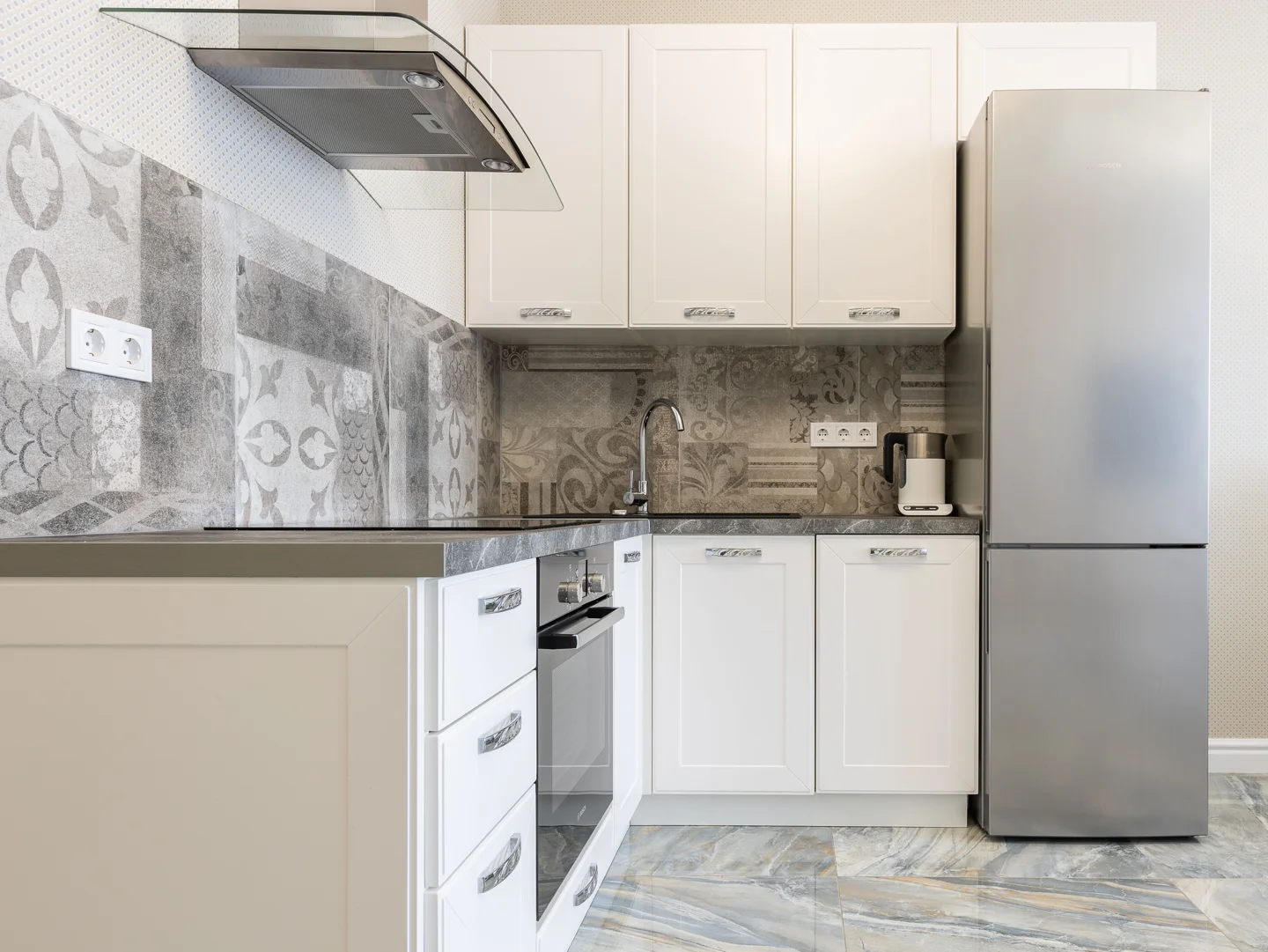
A fridge and an oven occupy the same kitchen without necessarily belonging to the same insurance category. A freestanding appliance generally points toward contents, while a component built into the kitchen points toward buildings. This starts the classification; it does not promise payment for every loss. That also requires identifying the event, applicable conditions and any particular arrangements.
Identify the appliance, rather than only the room
The Dutch Association of Insurers' example classification makes the distinction concrete: freestanding fridges and cookers appear under contents, while built-in kitchen appliances appear under buildings. The document explicitly describes itself as a nonbinding aid. Use it to formulate a specific question rather than replace your own policy.
Univé's explanation of kitchen damage also distinguishes the fitted kitchen from movable items. This shows why ‘damage to my kitchen’ is too broad. Does it concern the freestanding fridge, built-in oven, cabinet front or worktop? Record each affected component separately.
The visible arrangement provides useful information without necessarily resolving every borderline case. An appliance standing between cupboards does not automatically become equivalent to an integrated component. Describe what you know about its installation and ask which definition the insurer applies to the object. You do not need to remove an appliance or investigate its connections to ask that question.
Ownership and tenure are separate questions
The boundary between contents and buildings does not establish who owns the appliance. In a rented home, the fitted kitchen may belong to the landlord while a freestanding fridge belongs to the resident. Record ownership alongside the object and retain relevant tenancy or handover arrangements. Proof of payment for an appliance and an agreement about responsibility are different documents.
Improvements installed by a resident deserve their own check. The Centraal Beheer wording consulted addresses tenant improvements and apartment-owner improvements within that particular contents contract. This illustrates why ‘it is fixed, so my contents policy can never be relevant’ may be too simple. Check whether your own contract contains such a provision, which improvements it includes and what limits apply.
In an apartment, a building policy arranged through the owners' association, or VvE, may also be relevant. Ask for the applicable documents and the treatment of individual improvements. Do not assume a collective policy covers every personal purchase or alteration merely because it exists.
Classification does not establish cover
Suppose one incident affects both a freestanding fridge and a fixed kitchen component. Separate the objects while keeping the factual account of the incident consistent. The cause of an incident differs from the damage to each item. Even a correctly classified appliance may fall outside particular cover because of the insured-event definition or a relevant exclusion.
An inventory does not prove that an event is insured either. It helps identify the object, configuration and ownership. Where available, keep an overview photograph, model details, purchase information and a record of who arranged installation. Do not turn assumptions into facts when something is missing; identify what remains unknown.
Ask a question the insurer can resolve
For a borderline case, ask more than ‘Is my kitchen insured?’ A useful description identifies the appliance, whether it is freestanding or built-in as far as known, its owner and your living arrangement. Include the relevant policy version and ask for the provision supporting the classification.
This keeps three decisions separate: what kind of object it is, whose insurance or specific extension may be relevant, and whether the actual damage falls within that contract. A simple kitchen photograph can clarify the first question without automatically answering the other two.